The Aerodynamics of Fashion
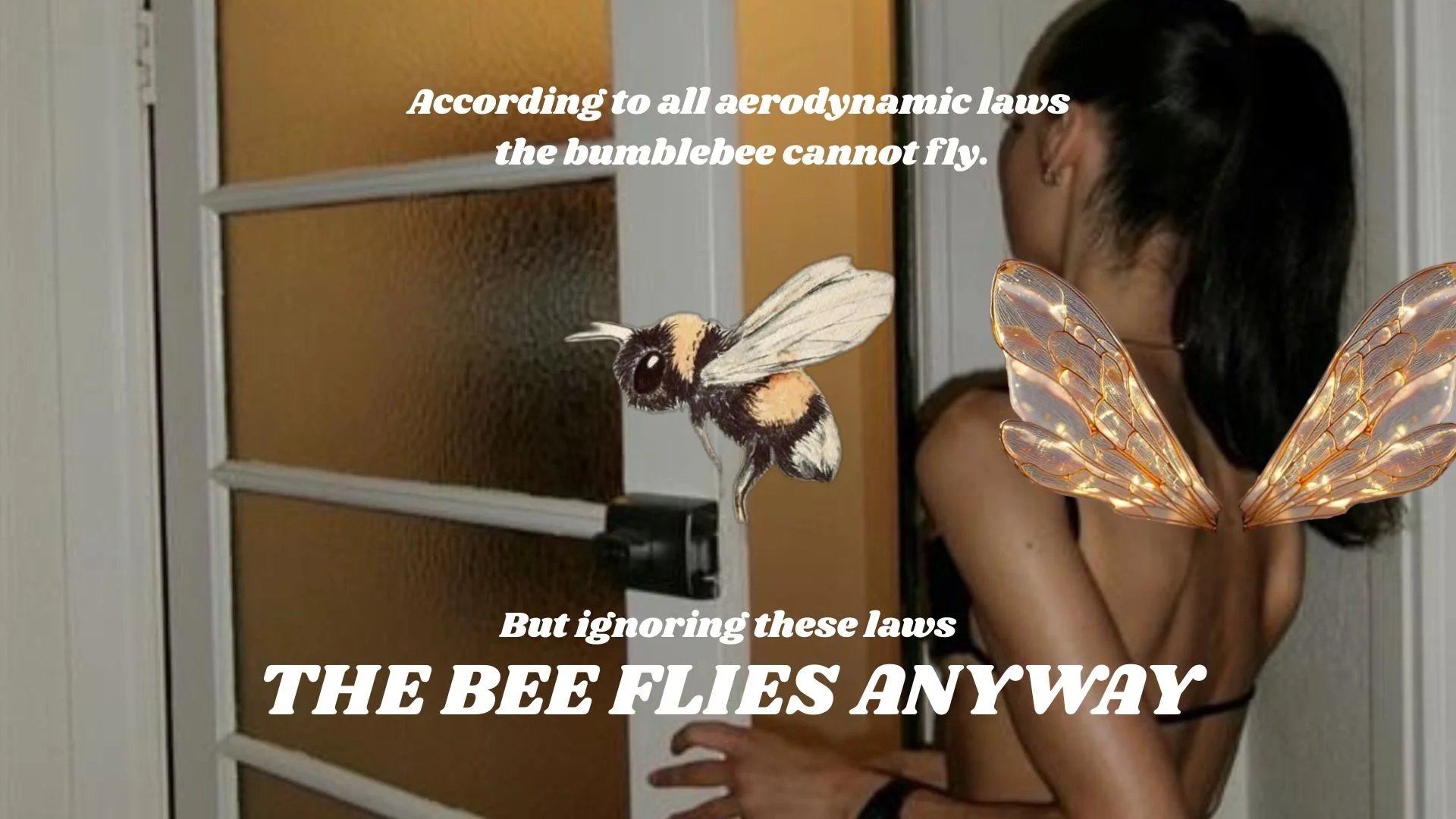
According to a well-known claim in aerodynamics, the bumblebee shouldn’t be able to fly. Its body is too heavy relative to its wingspan. The physics don’t reconcile.
And yet the bee flies.
The story is often used as motivational advice - believe in yourself, defy the odds, fly anyway.
Except it isn’t true.
Bumblebees can fly perfectly well within the laws of aerodynamics. The myth comes from a 1930s calculation that tried to analyse a bee using the physics of fixed-wing aircraft. Under that model, the numbers didn’t add up. The wings were too small, the body too heavy, the lift insufficient.
So the conclusion wasn’t that the model was wrong. It was that the bee was defying physics.
But bees don’t fly like aeroplanes. Their wings rotate and beat in ways that create swirling vortices of air, generating lift through a different mechanism. When scientists later studied how bees actually move, the maths worked.
The bee was never breaking the laws of nature. The framework being used to measure it was simply the wrong one.
Which makes the story far more interesting than the motivational version.
Because the real lesson isn’t about defying the odds - it’s about what happens when we mistake our models for reality.
And once you start looking for it, this mistake appears everywhere.
Especially inside organisations.
When the Model Becomes the System
Businesses rely on models to make sense of complex systems.
KPIs, forecasts, productivity metrics, margin targets - these frameworks turn complexity into something measurable and manageable.
But models do more than describe systems. They shape them.
Once a metric becomes the definition of success, the system begins reorganising itself around it. Decisions align. Incentives follow. Behaviour adapts.
Over time, the model stops describing the system.
It starts defining it.
The problem begins when the model no longer reflects the reality it is meant to represent.
Fashion’s Efficiency Trap
Few industries illustrate this tension more clearly than fashion.
For decades, fashion has optimised around a familiar set of metrics: margin, sell-through, stock turn, lead times, cost per unit. These are not arbitrary - they are logical within a system designed for scale and efficiency.
And under those rules, the system performs as expected.
It produces more garments, faster, at lower cost.
But embedded in that optimisation is an assumption: that more is better. More volume. More units. More growth.
The problem is that sustainability requires something structurally different. Lower throughput. Longer product lifespans. Circular systems instead of linear flow.
When sustainability enters the system, it often appears inefficient.
A longer-lasting garment can reduce repeat purchase rates. Repair models slow turnover. Lower production volumes can resemble missed growth.
So under the industry’s current logic, sustainability can resemble underperformance.
Not because it is - but because the model was built to reward volume.
And systems consistently produce what they are designed to reward.
The Organisational Blind Spot
This misalignment doesn’t exist only at an industry level. It exists inside organisations.
Sustainability teams are often tasked with transforming supply chains they don’t fully sit within or fully see. Meanwhile, merchandising and buying teams - the people closest to how product actually moves - are measured almost entirely on commercial performance.
So different parts of the organisation end up working from different maps of the same system.
Sustainability teams introduce reporting requirements, data requests, and supplier frameworks designed to improve visibility and reduce impact. Meanwhile, merchandising teams operate within tight planning cycles, margin pressures, and allocation systems that were never designed for those inputs.
The result is not resistance. It is translation… And when models don’t align, the system appears broken
The Data Illusion
Modern sustainability efforts often focus heavily on measurement.
Dashboards. Traceability tools. Supplier scorecards. Emissions platforms.
This visibility matters. But data alone does not change system behaviour.
A company can track every input in its supply chain and still overproduce. It can map every supplier and still optimise for cost. It can increase transparency without shifting outcomes.
Better measurement does not automatically produce better systems. It simply makes existing systems easier to observe.
When Systems Produce No One’s Intent
Overproduction is a clear example.
No single actor intends waste. Factories need scale. Retailers hedge against uncertainty. Buyers protect availability. Commercial systems are built to minimise risk and maximise performance.
Individually, each decision is rational. Collectively, the outcome is excess.
This is what systems thinking reveals: outcomes are not always the result of intent. They are the product of structure.
Where This Leaves Us
The idea of a fully sustainable fashion industry is often treated as the end goal. But that framing starts to blur once you look at the system more closely. Fashion is built on renewal and desire, but it also depends on continuous consumption rather than occasional demand.
That doesn’t make change irrelevant - it changes the question.
The question is no longer whether fashion can become sustainable in an absolute sense, but what more sustainable actually looks like inside a system still driven by consumption.
If there is a path forward, it does not sit in separating sustainability from commercial decision-making. It sits in embedding it into the structures that already shape those decisions.
That means moving away from standalone sustainability targets that exist alongside trading plans, and instead building sustainability into the way those plans are formed in the first place.
It looks like scenario-based planning that includes environmental constraints by default. It looks like material strategies embedded into buying frameworks rather than negotiated after the fact. It looks like carbon becoming a variable in product decisions, not a report at the end of season.
None of these changes remove commercial pressure. They work within it. But they change what that pressure produces.
Because systems don’t shift when new priorities are added. They shift when those priorities change the way decisions are made.
A More Practical Reframe
If sustainability is a systems problem, then where it sits inside organisations matters.
In many cases, sustainability teams sit within finance or commercial functions, where their work is filtered through cost, efficiency, and reporting structures designed for different priorities. That placement shapes what is possible before any work begins.
A more effective model may be to position sustainability alongside traditional commercial functions - not separate from the business, but not constrained by its legacy measurement systems either.
But structure alone is not enough. It also requires embedding sustainability capability directly into the parts of the organisation where decisions are made. Instead of broad, generalised sustainability roles that operate across entire organisations, there is a case for specialist roles within operational functions.
For example, sustainability-merchandising specialists who bridge product development and environmental impact. Or supply chain sustainability leads embedded within sourcing and planning teams, translating in real time between commercial decisions and system-level consequences.
The point is not to add more governance. It is to move expertise into the decision-making flow.
This is where systems thinking becomes essential.
Instead of asking why sustainability is difficult to implement, the more useful question is what the system is actually optimised to produce.
If the system rewards speed, volume, and efficiency above all else, those are the outcomes it will continue to generate.
Changing outcomes requires changing the model - the metrics, incentives, and assumptions that define success.
Without that shift, sustainability remains something the system tries to accommodate, rather than something it is designed to achieve.
Closing
The bee never had an aerodynamics problem. Someone had simply tried to understand it using the wrong model.
And in fashion - and in business more broadly - the same mistake keeps repeating itself.
We optimise what we can measure. We measure what we understand. And we mistake that understanding for reality.
Sometimes the limitations we think we are pushing against are not laws of nature.
They are just someone else’s bad maths.
The views, information, and opinions expressed in this article are solely my own and do not reflect the official policy or position of my employer, its parent companies, subsidiaries, affiliates, or any other organisation or entity with which I am associated.
Any content published here is not endorsed, reviewed, or approved by my employer. All information shared is based on my personal experience and understanding. While I strive for accuracy and currency in all content, I make no representations as to the completeness, reliability, or accuracy of this information.